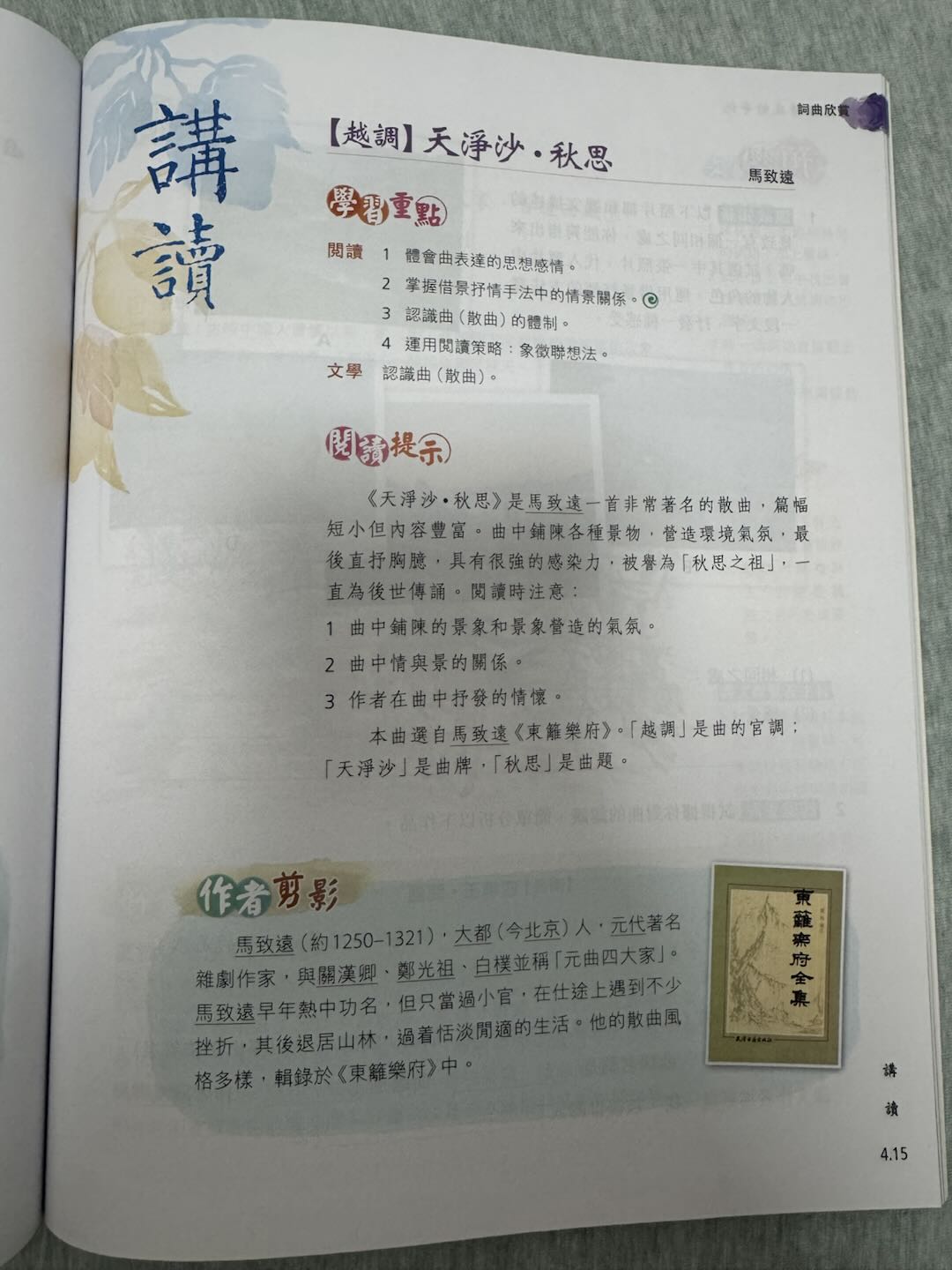
Page 4.15 · Lecture guide for "Tian Jing Sha · Qiu Si" (Learning Focus + Reading Hints + Author Profile)
"Autumn Thoughts" by Ma Zhiyuan · Yuan Sanqu Classic · "Ancestor of Autumn Melancholy"
Page 4.15 · Lecture guide for "Tian Jing Sha · Qiu Si" (Learning Focus + Reading Hints + Author Profile)
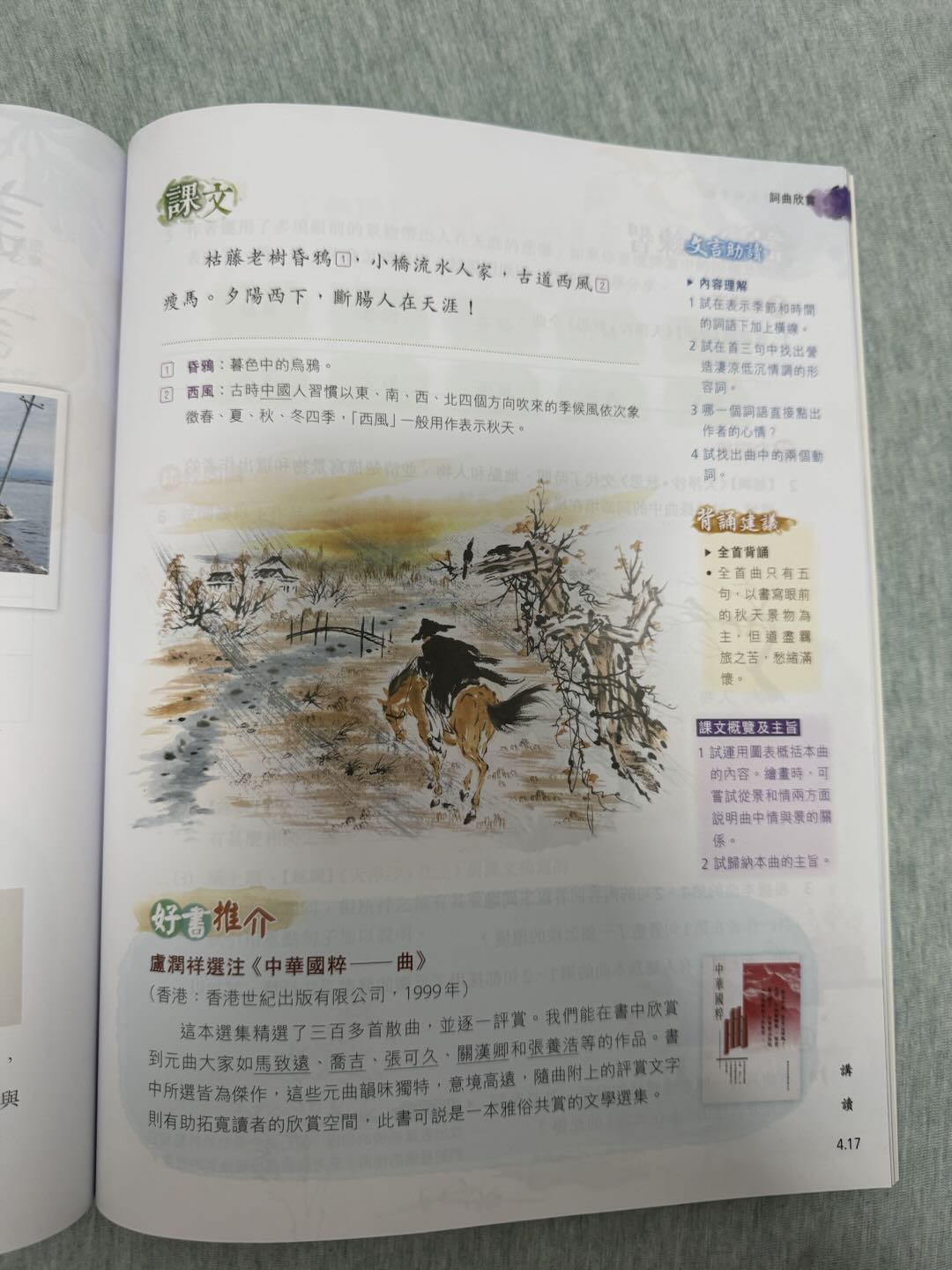
Page 4.17 · Full poem text (with annotations, classical Chinese reading aids, memorization tips, and lesson summary)
Tian Jing Sha · Qiu Si is one of Ma Zhiyuan's most celebrated sanqu pieces — short in length but rich in content. The poem strings together a series of autumn scenes to build atmosphere before its direct emotional climax, giving the work extraordinary impact. It has been honoured as the "Ancestor of Autumn Melancholy" and has been recited by generations ever since. While reading, notice:
This poem comes from Ma Zhiyuan's "Dongli Yuefu". "Yuediao" refers to the musical mode; "Tian Jing Sha" is the tune title; "Qiu Si" ("Autumn Thoughts") is the poem's subject line.
| Item | Details |
|---|---|
| Lifespan | c. 1250 - 1321 CE |
| Birthplace | Dadu (modern Beijing) |
| Dynasty | Yuan dynasty |
| Status | One of the "Four Great Yuan Playwrights" (alongside Guan Hanqing, Zheng Guangzu, Bai Pu) |
| Profession | Renowned zaju (variety play) playwright |
| Life Journey | Eager for official honours in his youth but only served in minor posts; after many setbacks, he retired to a quiet, reclusive life in the mountains |
| Collected Works | His sanqu pieces are compiled in "Dongli Yuefu" |
| Style | Diverse range across his sanqu corpus |
Withered vines, old trees, evening crows; a small bridge, flowing water, cottages; an ancient road, west wind, a lean horse.
By the setting sun, a heartbroken man at the edge of the world!
| Original Line | Key Terms | Analysis |
|---|---|---|
| Withered vines, old trees, evening crows | withered / old / evening | Three images of decay stacked together build a bleak, withering autumn atmosphere. The withered vine clings to the old tree; crows return at dusk — pure imagery of decline. |
| Small bridge, flowing water, cottages | small bridge / flowing water / cottages | Forms a sharp contrast with the previous line: shifting from decay to warmth. Yet the warmer the "cottages" appear, the more they emphasise the homelessness of the "heartbroken man". |
| Ancient road, west wind, lean horse | ancient / west / lean | The ancient road = a long-forgotten path; west wind = autumn wind; lean horse = an exhausted horse. Three travel images hint at the hardship of wandering. |
| By the setting sun | setting sun | "The setting sun" = the day's end, also symbolising life's twilight and loss. The image drives the poem toward its climax. |
| A heartbroken man at the edge of the world | heartbroken / edge of the world | "Heartbroken man" = a grief-stricken wanderer; "edge of the world" = a remote, rootless place. The poem's masterstroke, condensing all preceding imagery into a single word: sorrow. |
| No. | Term | Meaning |
|---|---|---|
| ❶ | 昏鴉 (hūn yā) | Evening crows; crows in the twilight sky. |
| ❷ | 西風 (xī fēng) | "West wind". In traditional Chinese culture, the seasonal winds from the four cardinal directions symbolise the four seasons in order — east wind for spring, south wind for summer, west wind for autumn, north wind for winter. "West wind" is therefore commonly used to indicate autumn. |
Words to underline: withered, old, evening (autumn mood); "by the setting sun" (time near dusk).
Six adjectives: withered, old, evening (withered vines, old trees, evening crows); ancient, west, lean (ancient road, west wind, lean horse). These decay-marking adjectives together construct a bleak, desolate, sorrowful atmosphere.
"heartbroken" directly conveys the poet's overwhelming grief. The word signals the deepest sorrow and is the masterstroke of the poem.
Two verbs: "sinks" (the sun sinks in the west) and "is" (the heartbroken man is at the edge of the world). All other words are nouns (with adjectives).
The poem has only five lines, built primarily on stacked autumn images, but the meaning is deep and enduring, and the sorrow runs deep.
Scenery: withered vines, old trees, evening crows, small bridge, flowing water, cottages, ancient road, west wind, lean horse, setting sun
Emotion: a heartbroken man at the edge of the world (homesickness, rootless wandering)
Scenery–emotion relationship: ten autumn scenes (scenery) → layered presentation → "heartbroken man" (emotion) = scenery and emotion in harmony
Through depictions of bleak autumn scenes, this sanqu expresses a wanderer's homesickness and a sense of rootless loneliness, conveying the poet's reflections on the wandering life. Honoured as the "Ancestor of Autumn Melancholy", it stands as a classic of Yuan sanqu.
(Hong Kong: Hong Kong Century Publishing Co., Ltd., 1999)
This anthology carefully selects more than three hundred sanqu pieces and provides commentary for each. Readers can savour the works of Yuan sanqu masters such as Ma Zhiyuan, Qiao Ji, Zhang Kejiu, Guan Hanqing, and Zhang Yanghao.
The selection features masterpieces; these sanqu pieces are uniquely flavoured and lofty in mood, and the accompanying commentary broadens the reader's appreciation space. The book can be called an anthology of literature that appeals to both refined and popular tastes.
This sanqu is among Ma Zhiyuan's most representative works, written during his period of career disappointment and reclusion in the mountains. Through bleak autumn imagery, the poem channels the homesickness of a wanderer far from home.
Sanqu is a verse form that rose to prominence after ci poetry. Like ci, it originated as lyrics set to music. Sanqu has the following features:
| Aspect | Ci (詞) | Sanqu (散曲) |
|---|---|---|
| Dynasty | Flourished in the Song dynasty | Flourished in the Yuan dynasty |
| Form | Lines of varying length, more literary | Lines of varying length, more colloquial |
| Sub-types | Xiaoling, zhongdiao, changdiao | Xiaoling, taoshu |
| Major Writers | Su Shi, Li Qingzhao | Guan Hanqing, Ma Zhiyuan |
The "Four Great Yuan Playwrights" (元曲四大家) refers to the four most outstanding Yuan-dynasty zaju playwrights:
| Playwright | Pen Name | Representative Works |
|---|---|---|
| Guan Hanqing | Style name Yizhai Sou | The Injustice to Dou E, The Single Sword Meeting |
| Ma Zhiyuan | Style name Dongli | Tian Jing Sha · Qiu Si, Han Palace Autumn |
| Zheng Guangzu | Style name Dehui | The Soul of Qiannü, Wang Can Ascends the Tower |
| Bai Pu | Style name Taisu; pen name Langu | Rain on the Wutong Tree, Beyond the Wall |
| Term | Pronunciation | Meaning |
|---|---|---|
| Sanqu (散曲) | sǎn qǔ | Yuan dynasty verse form; includes xiaoling (short pieces) and taoshu (suites) |
| Gongdiao (宮調) | gōng diào | Musical mode in Chinese music (e.g., yuediao, shuangdiao) |
| Qupai (曲牌) | qǔ pái | The fixed metrical pattern name for a tune |
| Xiaoling (小令) | xiǎo lìng | A short, single-tune sanqu piece |
| Taoshu (套數) | tào shù | A suite of sanqu pieces sharing one musical mode |
| Four Great Yuan Playwrights | yuán qǔ sì dà jiā | Guan Hanqing, Ma Zhiyuan, Zheng Guangzu, Bai Pu |
| Dongli Yuefu (東籬樂府) | dōng lí yuè fǔ | Ma Zhiyuan's sanqu collection; "Dongli" is his pen name |
This poem is a textbook example of borrowing scenery for emotion — by depicting the bleak scenes of autumn, the poet channels the homesickness of a wanderer far from home.
In its opening eighteen characters, the poem stacks nine noun phrases to evoke ten autumn images:
The closing line, "By the setting sun, a heartbroken man at the edge of the world," delivers the emotional climax directly, gathering all preceding images into the wanderer's sorrow. Scenery and emotion become one seamless whole.
Reading through symbolic association:
How many nouns appear in the first eighteen characters of this sanqu? Into how many groups can the images be divided? What are they?
The first eighteen characters contain 9 nouns (stacking into 10 autumn scenes), divided into 3 image groups:
The poem has only two verbs among its 28 characters. Which are they? What other parts of speech fill the rest?
The two verbs are:
The other 26 characters are all nouns (including some adjectives, but no linking verbs such as "is," "has," or "seems"). This stacking of nouns with very few verbs is the poem's most distinctive artistic feature.
"A small bridge, flowing water, cottages" is clearly a warm, homely scene — why does it make the poem feel even sadder?
This is the foil technique:
Why is "a heartbroken man at the edge of the world" called the poem's "masterstroke"?
The line is the masterstroke for three reasons:
Why can "west wind" be used to indicate autumn?
In traditional Chinese culture, the seasonal winds from the four cardinal directions symbolise the four seasons in order:
This reflects China's geographic position and climate. China sits on the eastern edge of the Eurasian continent, where winter brings north winds (from Siberia sweeping south) and autumn brings west winds; "west wind" therefore appears in many autumn poems.
Examples: Ma Zhiyuan's "ancient road, west wind, lean horse" and Li Qingzhao's many autumn scenes all use "west wind" for autumn mood.
Who wrote Tian Jing Sha · Qiu Si? In which dynasty did he live?
The author is Ma Zhiyuan, pen name Dongli, a Yuan dynasty writer (c. 1250-1321) from Dadu (modern Beijing). He is one of the "Four Great Yuan Playwrights" (alongside Guan Hanqing, Zheng Guangzu, Bai Pu) and a celebrated zaju playwright.
In the title "Tian Jing Sha · Qiu Si," what does each part — "Yuediao," "Tian Jing Sha," and "Qiu Si" — refer to?
The full naming convention is: "Yuediao" = the musical mode; "Tian Jing Sha" = the tune title (metre pattern); "Qiu Si" = the poem's subject line.
Who are the "Four Great Yuan Playwrights"?
The "Four Great Yuan Playwrights" are:
Mnemonic: "Guan Ma Zheng Bai"
What are the main writing techniques used in this sanqu?
The main techniques are:
From which collection is this sanqu taken? Is it a xiaoling or a taoshu?
This sanqu comes from Ma Zhiyuan's "Dongli Yuefu". It is a xiaoling (a short, single-tune sanqu of only 28 characters).
What thoughts and feelings does this sanqu express?
The poem conveys the homesickness of a wanderer far from home and the loneliness of a rootless, drifting existence. Through the bleak autumn imagery, it reflects the poet's reflections on life's transience and wandering.