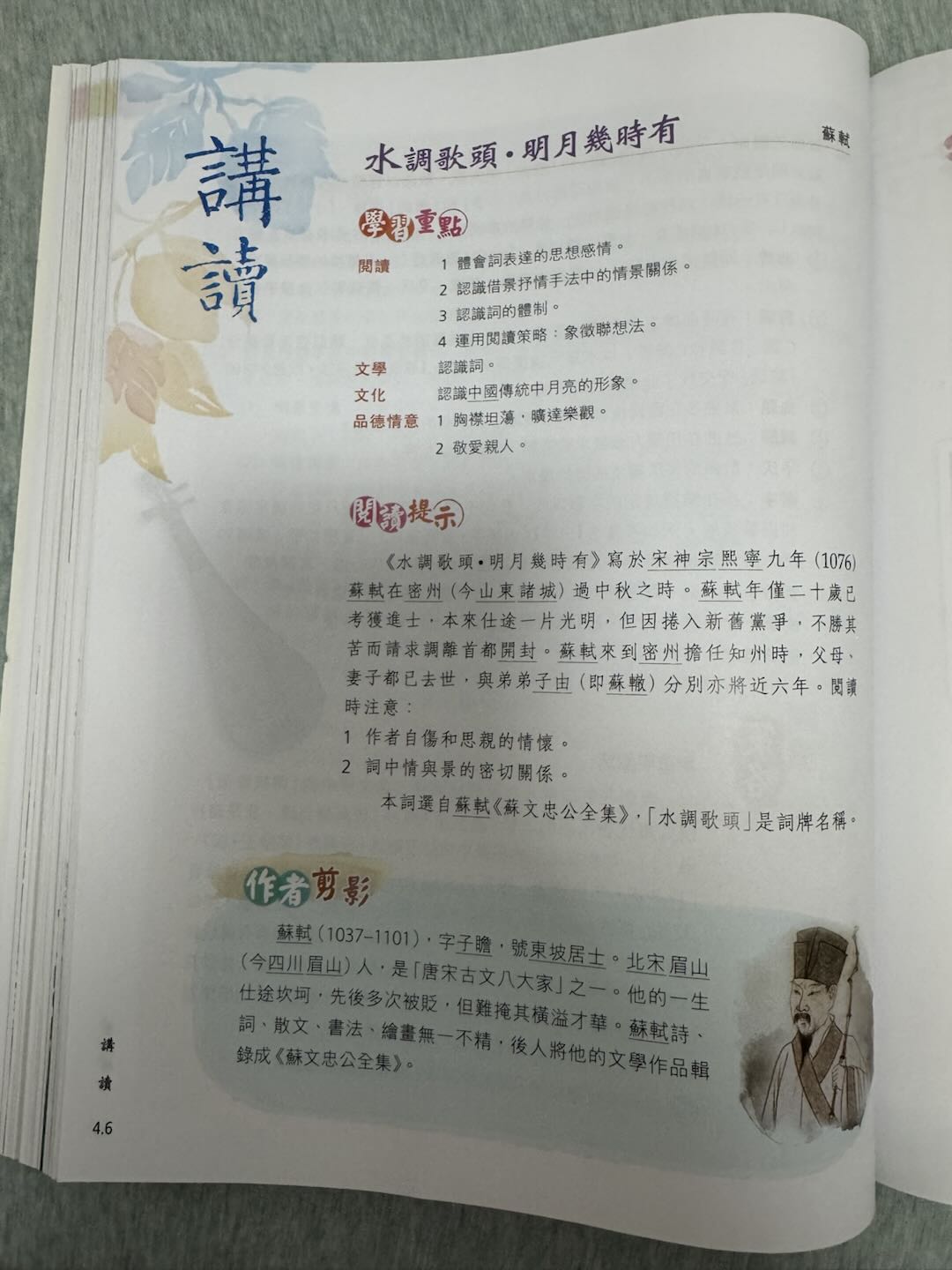
Page 4.6 · Lecture guide (Learning Focus + Reading Hints + Author Profile)
"Shǔidiào Gētóu · Míngyuè Jǐshí Yǒu" by Sū Shì · Ci Poem Classic · Mid-Autumn Reflections
Page 4.6 · Lecture guide (Learning Focus + Reading Hints + Author Profile)
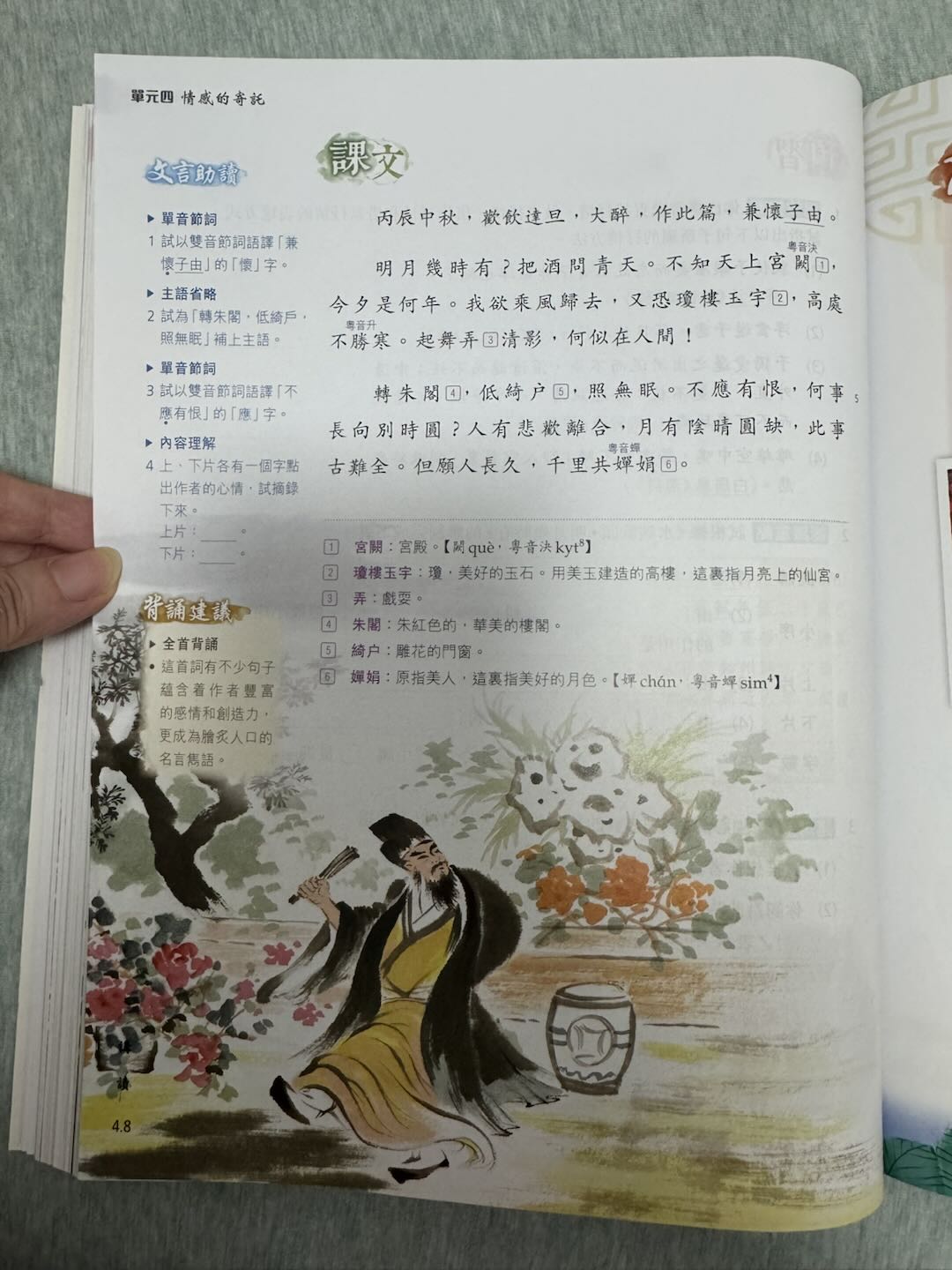
Page 4.8 · Full poem text (with classical Chinese reading aids, annotations, and memorization tips)
On the Mid-Autumn night of the Bingchen year, I drank happily until dawn, became thoroughly drunk, and wrote this piece to cherish the memory of my brother Ziyou.
When did the bright moon first appear? I raise my cup to question the azure sky.
I wonder what year it is tonight in the heavenly palace above.
I long to ride the wind and make my way home, yet I fear the jade towers and crystal halls, where the lofty heights are too cold to bear.
I rise and dance, playing with my clear shadow — how could this be any worse than the human world!
| Original Line | Key Term | Analysis |
|---|---|---|
| When did the bright moon first appear? I raise my cup to question the azure sky. | raise my cup to question the sky | Alludes to Li Bai's "When did the bright moon first appear before the blue sky?" The opening gesture of questioning the moon is grand and sweeping. |
| I wonder what year it is tonight in the heavenly palace above. | heavenly palace | The poet extends his question from the moon to the celestial realm, drifting into the realm of immortals. |
| I long to ride the wind and make my way home | ride the wind homeward | "Make my way home" suggests returning to heaven. Su Shi presents himself as a banished immortal temporarily stranded in the mortal world. |
| Yet I fear the jade towers and crystal halls, where the lofty heights are too cold to bear. | jade towers / too cold to bear | The phrase shifts from desire to return to fear of returning — a deliberate reversal that builds tension. |
| I rise and dance, playing with my clear shadow — how could this be any worse than the human world! | playing / shadow | The final resolution: the poet ultimately chooses to remain in the human world. The rhetorical question affirms the mortal realm. |
The moon turns past the crimson pavilion, dips low through the carved window, and shines on the sleepless one.
It should bear no grudge, yet why does it always round itself when we are parting?
People have their partings and reunions, the moon its waxing and waning — such things have never been perfect since ancient times.
May we all live long and share this graceful moonlight, though we are thousands of miles apart.
| Original Line | Key Term | Analysis |
|---|---|---|
| The moon turns past the crimson pavilion, dips low through the carved window, and shines on the sleepless one. | crimson pavilion / carved window | Three successive verbs (turns, dips, shines) track the moon's movement and signal the passage of time. The closing "sleepless one" reveals the poet's wakefulness and longing. |
| It should bear no grudge, yet why does it always round itself when we are parting? | why | The poet turns his resentment outward onto the moon — why must the moon be full precisely when loved ones are apart? |
| People have their partings and reunions, the moon its waxing and waning | antithesis | One of the most celebrated lines in Chinese literature. The parallel structure draws an analogy between human fortunes and natural cycles. |
| Such things have never been perfect since ancient times. | never perfect since ancient times | A philosophical turn: the poet moves from personal complaint to rational acceptance that imperfection is universal. |
| May we all live long and share this graceful moonlight, though we are thousands of miles apart. | graceful moonlight | The closing couplet elevates personal longing into a universal blessing, reaching the emotional climax of the entire poem. |
| Concept | Explanation | Examples from the poem |
|---|---|---|
| Single-Character Words | Classical Chinese often uses one character to express what modern Chinese expresses in two. Readers must mentally expand these into modern two-character compounds. |
兼 in "to cherish the memory" = "at the same time" 恨 in "should bear no grudge" = "resentment" 似 in "how could this be" = "to resemble" |
| Subject Omission | Classical Chinese frequently omits the subject. Readers should supply the implied subject, or the meaning becomes unclear. |
"Raise my cup to question the sky" — subject "I" omitted "Turns past the crimson pavilion" — subject "the moon" omitted "Shines on the sleepless one" — subject "the moon" omitted |
| Key Emotional Indicators | Each stanza contains one pivotal character that reveals the poet's inner state. Identify them carefully. |
Upper stanza: "cold" (too cold to bear) — signals the dilemma of transcendence vs. earthly life Lower stanza: "sleepless" (the sleepless one) — signals longing for loved ones |
| Word | Pronunciation | Meaning | From the Poem |
|---|---|---|---|
| 宮闕 (gōng què) | heavenly palace | The imperial palace. 闕 originally referred to the two watchtowers flanking a palace gate. | "I wonder what year it is tonight in the heavenly palace" |
| 瓊樓玉宇 (qióng lóu yù yǔ) | jade towers and crystal halls | Palaces built of precious jade — a metaphor for the Moon Palace. | "Yet I fear the jade towers and crystal halls" |
| 弄 (nòng) | to play with | To handle playfully; to amuse oneself with. | "I rise and dance, playing with my clear shadow" |
| 朱閣 (zhū gé) | crimson pavilion | A pavilion painted in vermilion red. | "The moon turns past the crimson pavilion" |
| 綺戶 (qǐ hù) | carved window | A window decorated with ornate carvings. | "Dips low through the carved window" |
| 嬋娟 (chán juān) | graceful / beautiful | Originally meaning "a beautiful woman"; here it refers to the beauty of the moonlight. | "Share this graceful moonlight" |
Through the lens of admiring the moon on Mid-Autumn night, the poet expresses personal sorrow and longing for loved ones, before elevating these feelings into a transcendent blessing for all separated souls. The poem embodies Su Shi's signature broad-mindedness and philosophical optimism.
Prelude to Water Melody was written in the 9th year of Song Shenzong's Xining era (1076) when Sū Shì was in Mizhou (modern Zhucheng, Shandong) during the Mid-Autumn Festival. Sū Shì was only forty years old and had already passed the imperial examination. Although his career seemed bright, he became embroiled in the factional struggles between the reformists and the conservatives, which led him to request a transfer from the capital Kaifeng. When Sū Shì arrived in Mizhou as prefect, his parents and wife had already passed away, and he had been separated from his younger brother Sū Zhé (Zǐyóu) for nearly six years. While reading, notice:
This ci is selected from the Complete Works of Sū Wénzhōng Gōng (《蘇軾文忠公全集》). "Shǔidiào Gētóu" is the name of the ci tune pattern.
| Item | Details |
|---|---|
| Lifespan | 1037 - 1101 CE |
| Courtesy name | Zǐzhān (子瞻) |
| Pen name | Dōngpō Jūshì (東坡居士) — "Hermit of the Eastern Slope" |
| Birthplace | Meishan, Sichuan (today) |
| Status | One of the "Eight Great Prose Masters of Tang and Song" |
| Artistic achievements | Mastered poetry, ci, prose, calligraphy and painting |
| Career | A bumpy official career with multiple banishments |
| Collected works | Compiled as Complete Works of Sū Wénzhōng Gōng (《蘇文忠公全集》) |
This ci was written in the 9th year of Xining (1076) of the Song Shenzong era, when Sū Shì served as prefect of Mizhou (modern Zhucheng, Shandong). He was forty years old at the time.
Ci is a form of classical Chinese poetry, also called "long and short lines" or "leftover of poetry". Originally lyrics set to music. Ci has the following features:
In traditional Chinese culture, the moon has multiple symbolic meanings:
| Symbolism | Meaning | Example |
|---|---|---|
| Longing for home | Moon full but family apart, the traveller misses home | "Lifting my head to gaze at the bright moon, lowering it I think of my hometown" (Lǐ Bái) |
| Longing for family | Looking at the moon and missing loved ones | This ci: "May we live long and share the same moonlight though far apart" |
| Reunion | Mid-Autumn full moon, family reunion | Eating mooncakes at Mid-Autumn |
| Solitude | Loneliness in the moonlight | "I raise a cup to invite the bright moon, with my shadow we become three" (Lǐ Bái) |
| Eternity | The moon is eternal and unchanging | "When did the bright moon first appear" |
| Word | Pronunciation | Meaning |
|---|---|---|
| 知州 zhīzhōu | zhī zhōu | Prefect (a Song dynasty local official) |
| 新舊黨爭 xīnjiùdǎngzhēng | xīn jiù dǎng zhēng | New-OLD party struggles (factional conflicts in the Song dynasty) |
| 中秋 zhōngqiū | zhōng qiū | Mid-Autumn Festival (15th day of the 8th lunar month) |
| 嬋娟 chánjuān | chán juān | Beautiful (here referring to the moon) |
| 闕 quē | quē | End of a musical piece; extended to mean a stanza |
| 子由 zǐyóu | zǐ yóu | Sū Zhé's courtesy name; Sū Shì's younger brother |
| 朱閣 zhūgé | zhū gé | crimson pavilion |
| 綺戶 qǐhù | qǐ hù | carved window |
| 瓊樓玉宇 qiónglóuyùyǔ | qióng lóu yù yǔ | jade towers and crystal halls (the Moon Palace) |
| 不勝 bùshēng | bù shēng | too ... to bear / unable to endure |
| 何似 hésì | hé sì | how could this compare to |
| 乘風 chéngfēng | chéng fēng | to ride the wind (figuratively, to ascend to heaven) |
What rhetorical device does "People have their partings and reunions, the moon its waxing and waning" use? What is its deeper meaning?
Rhetorical device: Antithesis (parallel structure pairing people with moon, and partings/reunions with waxing/waning).
Deeper meaning: By placing human fortunes alongside natural cycles, the poet suggests both are subject to the same inescapable laws. Once accepted, the wish for permanent fullness loses its urgency — a hallmark of philosophical equanimity.
In "I long to ride the wind and make my way home, yet I fear the jade towers and crystal halls, where the lofty heights are too cold to bear," what writing technique is employed, and what does it express?
Writing technique: Rhetorical feint (yù qín gù zòng — "to capture, first let go"), a classic reversal structure.
Meaning: The poet first expresses the wish to leave (desire to return), then voices fear (fear of returning), and finally chooses to stay and dance in the moonlight. This reversal of direction makes the final embrace of human life more emphatic, highlighting the poet's love for the mortal world.
What does jiān (兼) mean in "to cherish the memory of my brother Ziyou"? Provide two more examples of single-character words from the poem and their modern equivalents.
Meaning of 兼 (jiān): "at the same time" or "additionally."
Examples of single-character words:
In "Raise my cup to question the sky," the subject "I" is omitted. Find two other lines where the subject is omitted, and supply the missing subject.
💡 Pattern: Each stanza contains one pivotal character that reveals the poet's emotional state ("cold" in the upper, "sleepless" in the lower); the omitted subjects are almost always "the moon."
Arrange the poem's emotional progression in order, from low to high.
From low to high: Question → Desire → Stay → Watch → Resent → Realize → Bless
The closing line "May we all live long and share this graceful moonlight, though we are thousands of miles apart" represents the emotional climax — transforming personal longing for his brother into a universal blessing for all separated souls.
This ci is a classic example of borrowing scenery for emotions — by describing the moonlight and moon shadows, the author expresses feelings of self-pity and longing for family.
In the ci, emotion and scenery are closely linked:
The associative thinking through symbols reading strategy:
Who wrote Prelude to Water Melody? When did he live?
The author is Sū Shì (Su Dongpo), courtesy name Zǐzhān, pen name Dōngpō Jūshì, who lived from 1037-1101 CE in the Northern Song dynasty, from today's Meishan, Sichuan. He is one of the "Eight Great Prose Masters of Tang and Song".
When and under what circumstances was this ci written?
It was written on the Mid-Autumn Festival of 1076 when Sū Shì was serving as prefect of Mizhou (modern Zhucheng, Shandong). He was forty years old at the time. His parents and wife had all passed away, and he had been separated from his younger brother Sū Zhé for nearly six years.
What does the moon symbolise in traditional Chinese culture?
Moon symbolism:
What are the values expressed in this ci?
Values:
What is "Shǔidiào Gētóu"?
"Shǔidiào Gētóu" is the name of the ci tune pattern, said to be created during the Sui dynasty when Emperor Yang opened the Bian Canal, later used as a ci tune name. This ci has 95 characters in total, divided into upper and lower stanzas.
What are the main writing techniques in this ci?
Main techniques: