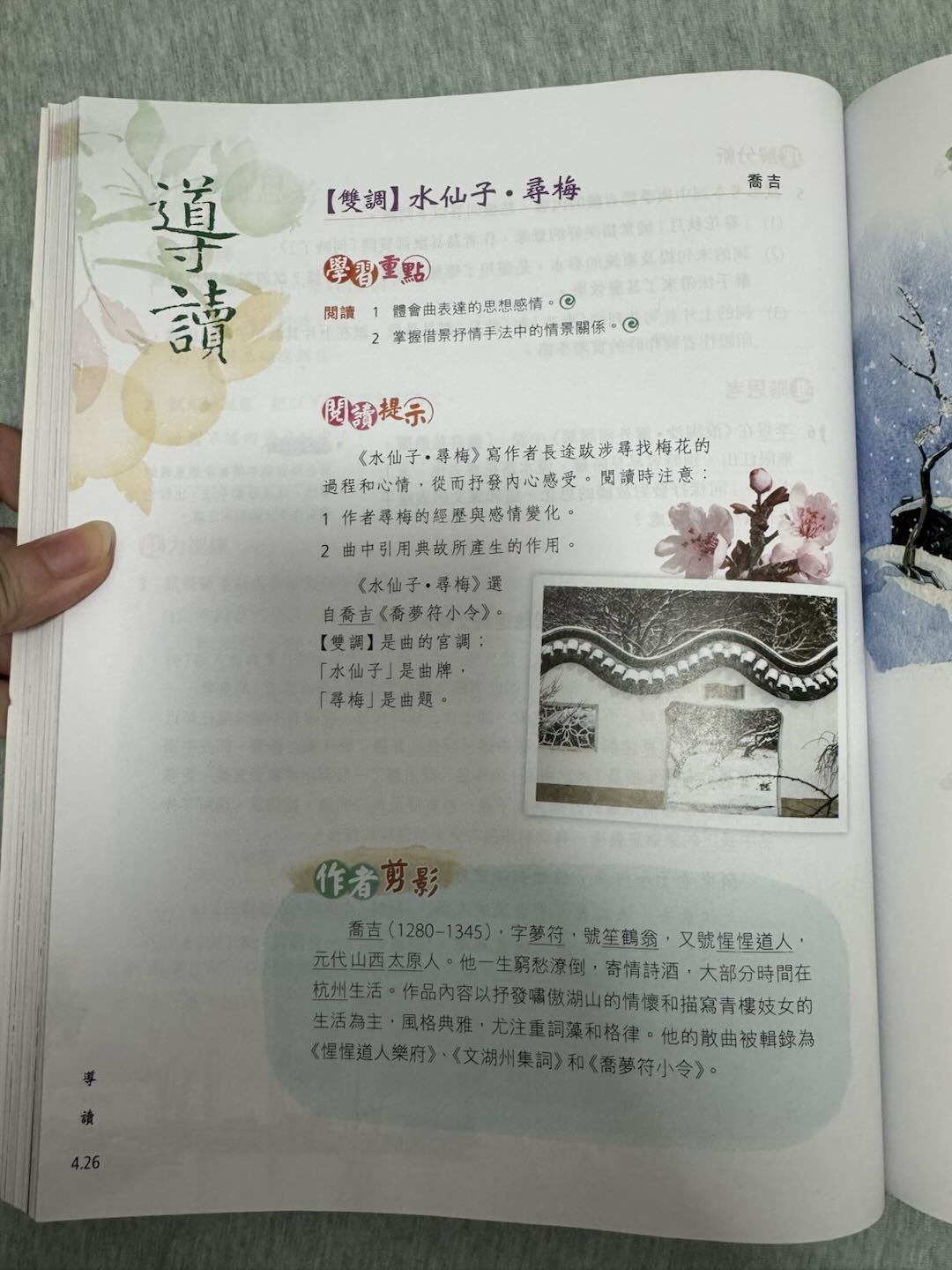
Page 4.26 · Reading guide for "Shuixianzi · Xunmei" (Learning Focus + Reading Hints + Author Profile)
"Seeking Plum Blossoms" by Qiao Ji · Yuan Dynasty Sanqu Classic · Refined Diction · Lofty Aspiration
Page 4.26 · Reading guide for "Shuixianzi · Xunmei" (Learning Focus + Reading Hints + Author Profile)
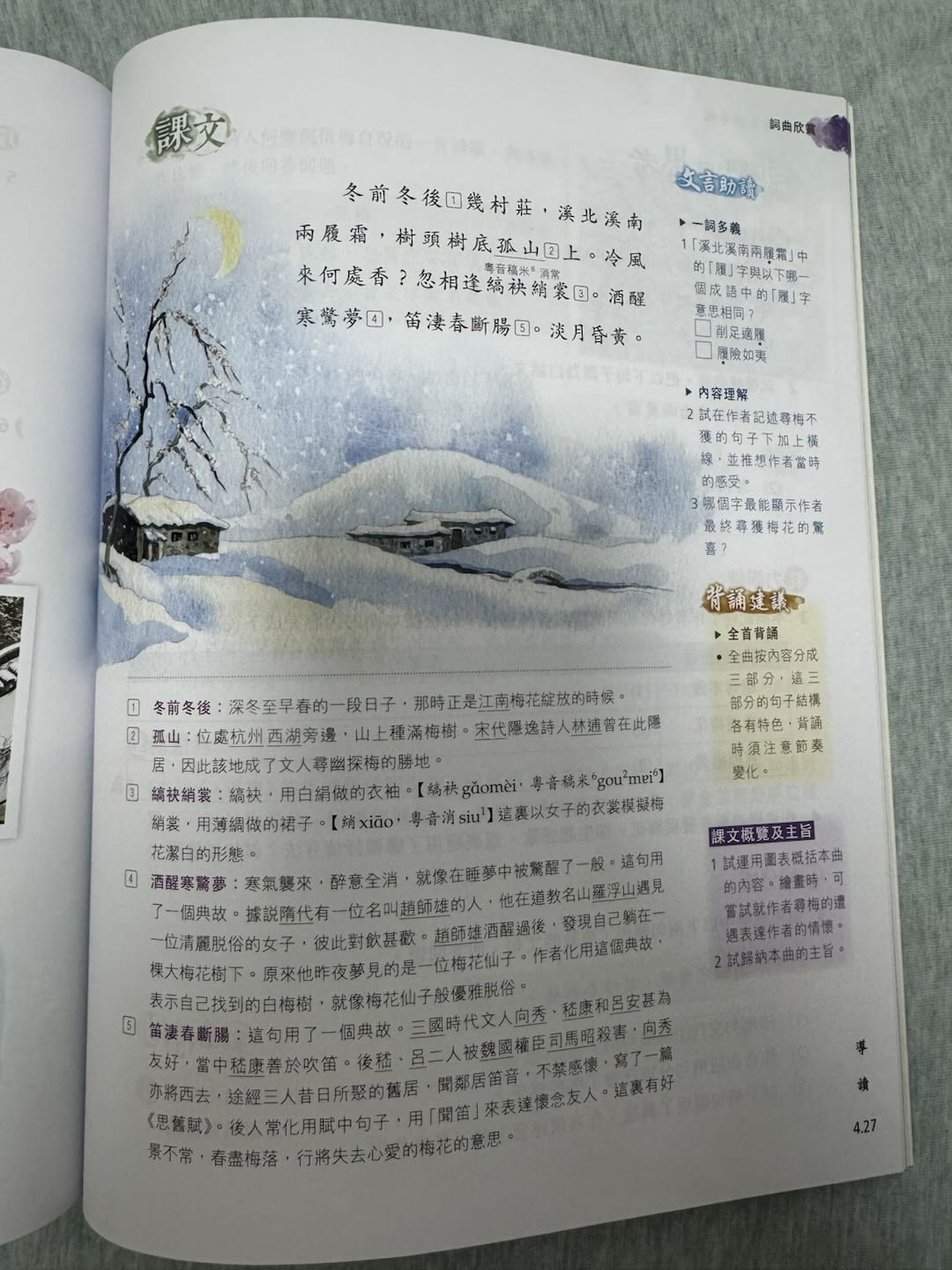
Page 4.27 · Full poem text (with five annotations, classical Chinese reading aids, memorisation tips, and lesson summary)
Shuixianzi · Xunmei describes the author's long journey in search of plum blossoms and the feelings it evokes. While reading, notice:
This sanqu is selected from Qiao Ji's "Qiao Mengfu Xiaoling". "Shuangdiao" is the musical mode; "Shuixianzi" is the tune title; "Xunmei" ("Seeking Plum Blossoms") is the subject line.
| Item | Details |
|---|---|
| Lifespan | 1280 - 1345 CE |
| Courtesy name | Mengfu (夢符) |
| Pen name | Shenghe Weng (笙鶴翁); Xingxing Daoren (惺惺道人) | >
| Birthplace | Taiyuan, Shanxi (Yuan Dynasty) |
| Status | A celebrated Yuan dynasty sanqu poet, paired with Zhang Kejiu as the "Two Masters of Yuan Sanqu" |
| Life Journey | Lived in poverty and frustration throughout his life, finding solace in poetry and wine |
| Where He Lived | Spent most of his time in Hangzhou |
| Subject Matter | ① Expressing a carefree disdain for lakes and mountains; ② Depicting the lives of courtesans in pleasure quarters |
| Style | Elegant and refined, with particular attention to diction and prosody |
| Collected Works | Xingxing Daoren Yuefu, Wen Huzhou Jici, and Qiao Mengfu Xiaoling |
How many villages, before and after winter, both sides of the stream, frost on both shoes, atop Lonely Hill❷ from treetop to treeroot.
From whence does the fragrance come on the cold wind? Suddenly I meet one in silken sleeves and gauzy skirts❸.
Awaking from wine, the cold startles my dream❹; the desolate flute makes spring break my heart❺; the pale moon, dusk-yellow.
The sanqu has seven lines, divided into three layers:
Mnemonic: Seek → Meet → Sense
| Original Line | Key Terms | <>Analysis |
|---|---|---|
| How many villages, before and after winter | before and after winter / how many villages | The opening line specifies the time of plum-seeking (deep winter to early spring, when plum blossoms bloom in Jiangnan) and the scope (several villages). |
| both sides of the stream, frost on both shoes | both sides of the stream / frost on both shoes | The shoes have frost on both sides, indicating that the seeker has walked a long distance and endured great hardship. A parallel structure that gives the verse a strong rhythm. |
| atop Lonely Hill from treetop to treeroot | treetop to treeroot / Lonely Hill | Searching from treetop to treeroot, the seeker finally arrives at Lonely Hill by West Lake (where the Song dynasty recluse Lin Bu lived in seclusion, planting plum trees everywhere). |
| Whence comes the fragrance on the cold wind? | cold wind / whence the fragrance | A sudden waft of fragrance on the cold wind; the interrogative leads into the joy of finding the plums. |
| Suddenly I meet one in silken sleeves and gauzy skirts | suddenly / silken sleeves and gauzy skirts | The "suddenly" conveys an unexpected, chance encounter; silken sleeves and gauzy skirts metaphorically describe the plum blossom, turning the abstract into the concrete. |
| Awaking from wine, the cold startles my dream | awaking from wine / cold / startling a dream | The chill arrives and sobers the drinker completely, as if startled out of a dream. Using the allusion of Zhao Shixiong meeting a plum fairy at Mount Luofu, the line praises the plum's elegant and refined air. |
| The desolate flute makes spring break my heart | desolate flute / break my heart | A sorrowful flute; spring is about to pass. Using the allusion of Xiang Xiu hearing the flute and mourning his lost friends, the line expresses the poet's sorrow at the imminent falling of the plum blossoms. |
| The pale moon, dusk-yellow | pale moon / dusk-yellow | The masterstroke of the sanqu. Under a pale moon, the sky turns dusk-yellow. The image is hazy and poetic, leaving an enduring resonance. |
| No. | Term | Meaning |
|---|---|---|
| ❶ | 冬前冬後 (dōng qián dōng hòu) | The period from deep winter to early spring — when plum blossoms are in full bloom in Jiangnan. |
| ❷ | 孤山 (gū shān) | Lonely Hill, located beside West Lake in Hangzhou, covered with plum trees. The Song dynasty recluse-poet Lin Bu once lived in seclusion here, making it a famous destination for scholars seeking plums. |
| ❸ | 縞袂綃裳 (gǎo mèi xiāo cháng) | Silken sleeves (gǎo mèi, sleeves of white silk) and gauzy skirts (xiāo cháng, skirts of thin gauze). A woman's clothing used here to evoke the pristine white form of the plum blossom. |
| ❹ | 酒醒寒驚夢 (jiǔ xǐng hán jīng mèng) | The chill arrives and the drinker is completely sobered, as if awakened from a dream. This line uses a literary allusion. Legend has it that in the Sui dynasty, a man named Zhao Shixiong met a beautiful woman on the sacred mountain Mount Luofu; they drank together. When Zhao awoke, he found himself lying under a great plum tree. What he had encountered in his dream the night before was a plum-blossom fairy. The poet adapts this allusion to suggest that the white plum tree he has found is itself as elegant and otherworldly as a plum-blossom fairy. |
| ❺ | 笛淒春斷腸 (dí qī chūn duàn cháng) | In the Three Kingdoms era, the literati Xiang Xiu, Ji Kang, and Lü An were close friends; Ji Kang was skilled at playing the flute. After Ji Kang and Lü An were killed by the Wei regent Sima Zhao, Xiang Xiu was about to depart westward; passing by the old gathering place of the three friends, he heard a neighbour playing the flute, was deeply moved, and wrote Si Jiu Fu ("Rhapsody on Recalling Old Friends"). Later generations often quote the phrase "hearing the flute" from this rhapsody to express the meaning of mourning friends. Here the line carries the meaning that good friends are rare, spring ends and the plums fall, and the beloved plums are about to be lost. |
The character "履" (lǚ) in "frost on both shoes" shares which meaning with the following dictionary citations?
In this sanqu, "frost on both shoes" uses "履" in the sense of "to tread upon; to step on".
Answer: Both B and C.
Underline the sentences that record the author's unsuccessful seeking of plums, and infer the author's feelings at the time.
Sentences to underline: "How many villages, before and after winter, both sides of the stream, frost on both shoes, atop Lonely Hill from treetop to treeroot" (the first three lines).
The author's feelings at the time:
Which single character best conveys the author's joy at finally finding the plum blossoms?
The character "忽" (hū, "suddenly") best conveys the author's joy at finally finding the plum blossoms.
"忽" means "suddenly, unexpectedly". After the hardship of seeking in the first three lines, the fourth line uses "忽相逢" ("suddenly I meet") to bring in the plum blossom, sweeping away the weariness and turning to unexpected joy.
The sanqu is divided into three parts by content; each part has its own distinctive sentence structure, so when memorising, pay attention to changes in word rhythm.
Chain the nine keywords together: 冬 (winter) / 溪 (stream) / 樹 (tree) / 何 (whence) / 忽 (suddenly) / 夢 (dream) / 笛 (flute) / 月 (moon).
Scenery: before and after winter, villages, both sides of the stream, frost, treetop to treeroot, Lonely Hill, cold wind, fragrance, pale moon, dusk-yellow.
Emotion: persistence in seeking plums, joy at meeting plums, deep sorrow at parting from plums.
Scenery–emotion relationship:
| Scenery (objective) | Emotion (subjective) |
|---|---|
| How many villages, before and after winter | The long duration and wide scope of plum-seeking |
| Both sides of the stream, frost on both shoes | Enduring hardship and persistent seeking |
| Atop Lonely Hill from treetop to treeroot | Searching from top to bottom |
| Whence comes the fragrance on the cold wind | A delightful surprise |
| Suddenly I meet one in silken sleeves and gauzy skirts | Unexpected joy of meeting the plum |
| Awaking from wine, the cold startles my dream | Admiration for the plum's refined elegance |
| The desolate flute makes spring break my heart | Sorrow at the imminent fall of the plums |
| The pale moon, dusk-yellow | Distant, lingering resonance |
By depicting the poet's long journey to seek plum blossoms, the unexpected encounter with them, and the reluctance to part with them, this sanqu expresses a longing for noble character and an appreciation of all that is beautiful. The two allusions of the Luofu dream (Zhao Shixiong) and Si Jiu Fu (Xiang Xiu) lend the work greater cultural depth and rich literary resonance. It is celebrated as a Yuan sanqu classic on the theme of "seeking plums".
This sanqu was written while Qiao Ji was living in Hangzhou. Seeking plum blossoms near West Lake in early spring, the poet uses the process of searching, asking about and praising the plum to express his own lofty aspiration and refusal to drift with the world.
In Chinese culture the plum blossom symbolises nobility, resilience and defiance against the snow. Poets of every age have used the plum as a self-image — for example, Lu You's "Ode to the Plum" and Wang Anshi's "Plum Blossoms". Qiao Ji's "seeking the plum" is, in essence, a quest for the noble character within himself, expressing the resolve not to drift with the crowd.
| Term | Pronunciation | Meaning |
|---|---|---|
| Qiao Ji | qiáo jí | A Yuan dynasty sanqu poet; courtesy name Mengfu |
| Shuangdiao | shuāng diào | One of the musical modes of sanqu |
| Shuixianzi | shuǐ xiān zǐ | The tune title of this sanqu |
| Xunmei | xún méi | "Seeking Plum Blossoms"; the poem's subject line |
| Xiaoling | xiǎo lìng | A short, single-tune sanqu piece (as opposed to taoshu) |
| Qiao Mengfu Xiaoling | qiáo mèng fú xiǎo lìng | The sanqu collection of Qiao Ji |
| Xingxing Daoren | xīng xīng dào rén | Qiao Ji's pen name; "the clear-headed Daoist" |
| Shenghe Weng | shēng hè wēng | Qiao Ji's pen name; "the old man with the sheng and the crane" |
| Diction | cí zǎo | The ornate choice of words in poetry and prose |
| Defiant pride in lakes and mountains | cháo ào hú shān | A mocking, lofty stance toward the beauty of nature |
This sanqu is a textbook example of borrowing scenery for emotion — through depictions of the plum-seeking journey and the scenes around the plum blossoms, the poet expresses his lofty aspiration.
The sanqu abounds in literary allusions (such as Princess Shouyang, Luofu, Wang Zhaojun), making the work elegant and ornate with a deep cultural heritage.
Scenery and emotion are seamlessly fused:
The sanqu uses many parallel couplets (such as "village after village before and after winter, frost on both shoes south and north of the stream"), giving the verse a measured cadence.
Into how many layers can the seven lines of this sanqu be divided? What does each layer describe?
The sanqu has seven lines, divided into three layers:
Mnemonic: Seek → Meet → Sense.
Which two allusions are used in "Awaking from wine, the cold startles my dream" and "The desolate flute makes spring break my heart"? What meanings do they carry?
Why is the word "suddenly" (忽) in "Suddenly I meet one in silken sleeves and gauzy skirts" so effective?
The word "suddenly" works effectively for three reasons:
What rhetorical device is used in "silken sleeves and gauzy skirts"? What is its effect?
Rhetorical device: metaphor (and personification).
Content: A woman's white silk sleeves and gauzy skirts stand in for the plum blossom's pristine white form.
Effects:
Why is "the pale moon, dusk-yellow" the masterstroke of the sanqu?
"The pale moon, dusk-yellow" is the masterstroke of the sanqu for several reasons:
Who wrote Shuixianzi · Xunmei? When did he live?
The author is Qiao Ji (courtesy name Mengfu; pen names Shenghe Weng and Xingxing Daoren), who lived from 1280-1345 CE in the Yuan dynasty. He was a celebrated sanqu poet, paired with Zhang Kejiu as the "Two Masters of Yuan Sanqu".
When and under what circumstances was this sanqu written?
The sanqu was written in the Yuan dynasty, while Qiao Ji was living in Hangzhou. He searched for plum blossoms near West Lake in early spring, and through the process of seeking, asking about and praising the plum, expressed his own lofty aspiration.
What do "Shuangdiao," "Shuixianzi" and "Xunmei" each refer to?
"Shuangdiao" is the musical mode; "Shuixianzi" is the tune title; "Xunmei" is the subject line. The sanqu is selected from Qiao Ji's "Qiao Mengfu Xiaoling" and is a xiaoling.
What are the stylistic features of Qiao Ji's works?
Qiao Ji's works are elegant and refined in style, with particular attention to diction and prosody, making extensive use of literary allusions; he has been honoured as a "master craftsman of the ci world". His subject matter focuses on defiant pride in lakes and mountains and on the lives of courtesans.
What are the main writing techniques of this sanqu?
Main techniques include:
What thoughts and feelings does this sanqu express?
The sanqu expresses Qiao Ji's pursuit of a noble character and his refusal to drift with the world. Through the long journey of seeking plum blossoms, he conveys admiration and longing for the spirit of the plum blossom — bold and undefeated against snow and frost — channeling his own aspiration and character.