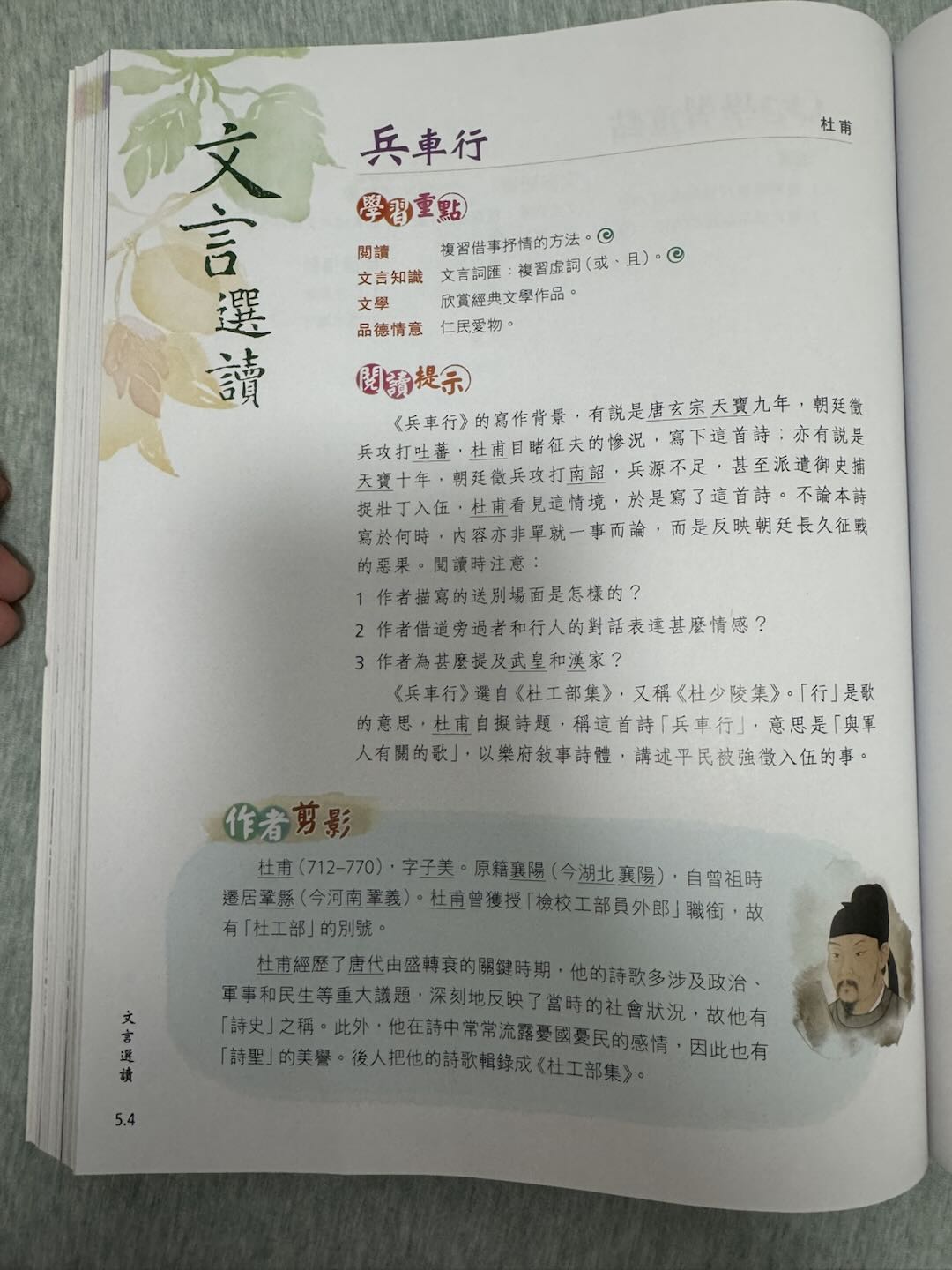
Page 5.4 · Reading guide for "Bing Che Xing)" (Learning Focus + Reading Hints + Author Profile)
"Song of the Army Carts" by Du Fu · Tang Dynasty Classic · Yuefu Narrative Poem · Unit 5: Classical Chinese Selections · "Poet-Historian"
Page 5.4 · Reading guide for "Bing Che Xing)" (Learning Focus + Reading Hints + Author Profile)
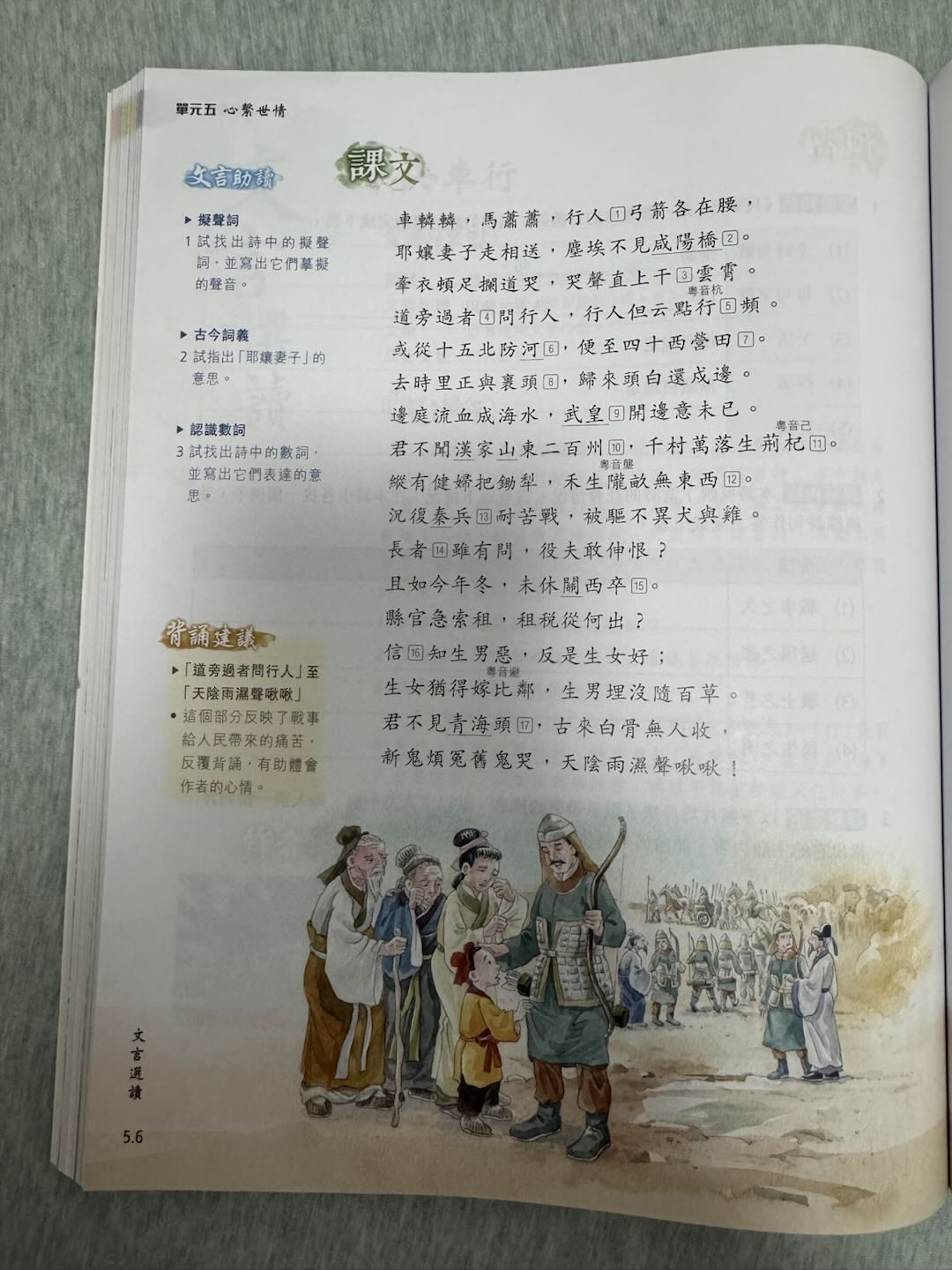
Page 5.6 · Full poem text (24 lines with 15 annotations, classical Chinese reading aids, memorisation tips, lesson summary, and a colour illustration)
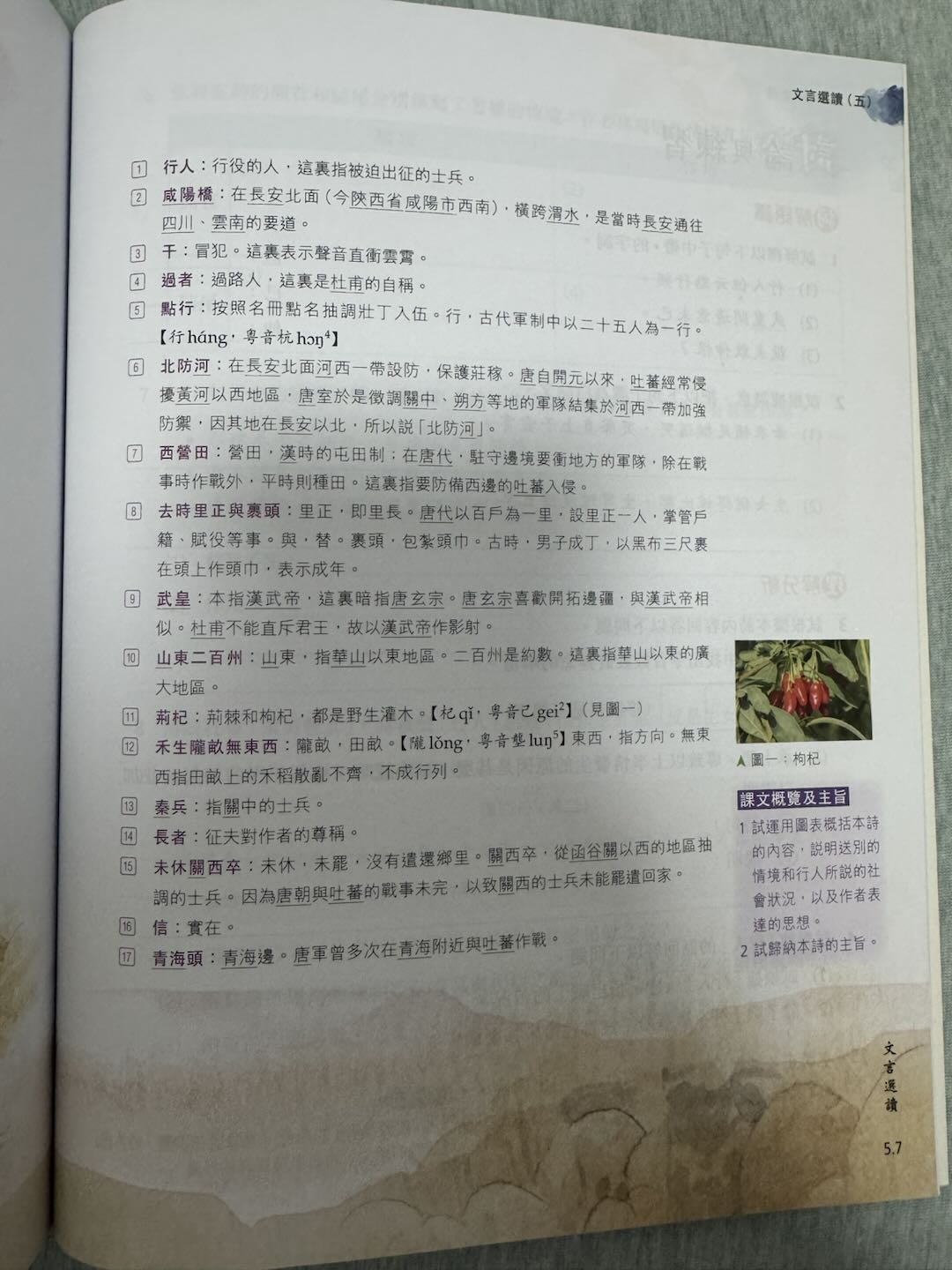
Page 5.7 · Detailed annotations (all 17 with Cantonese pronunciations), "Figure 1" photograph of wolfberry, and lesson summary
As for the background of Bing Che Xing, one account holds that it was written in the ninth year of the Tianbao era of Emperor Xuanzong of Tang, when the court raised troops to attack the Tibetan Empire and Du Fu witnessed the pitiful plight of the conscripts; another says it was the tenth year of Tianbao, when the court raised troops against Nanzhao, the supply of soldiers was insufficient, and imperial censors were even dispatched to seize able-bodied men into service; seeing this, Du Fu composed the poem. Whichever date is correct, the poem is not confined to any single incident but reflects the long-term evil consequences of the court's endless campaigns.
While reading, notice:
The poem comes from "Du Gongbu Ji", also known as "Du Shaoling Ji". "Xing" (literally "going") here means "song". Du Fu himself devised this poetic heading, naming the poem "Bing Che Xing" because it is "a song about people connected with the army carts". Composed in the yuefu narrative tradition, it tells the story of commoners forcibly conscripted into the army.
| Item | Details |
|---|---|
| Lifespan | 712 - 770 CE |
| Courtesy name | Zimei (子美) |
| Ancestral home | Xiangyang (modern Xiangyang, Hubei) |
| Family move | His great-grandfather relocated the family to Gongxian (modern Gongyi, Henan) |
| Dynasty | Tang dynasty (the crucial period of decline from the height of Tang prosperity) |
| Honorary title | "Du Gongbu" (after he was granted the honorary title "Vice Director of the Ministry of Works") |
| Reputation | "Poet-Sage" (詩聖, for supreme artistry) and "Poet-Historian" (詩史, for poems that record social reality) |
| Subject matter | Politics, military affairs, and people's livelihood |
| Emotional tone | Deep concern for the country and its people |
| Collected works | Du Gongbu Ji (also called Du Shaoling Ji) |
The poem was written during the Tianbao era of Emperor Xuanzong (around 750-756 CE), as the Tang dynasty was transitioning from prosperity to decline, with frequent border wars and mass conscription. Du Fu witnessed firsthand the suffering of the conscripts, particularly the forcible conscription of able-bodied men, and composed this yuefu narrative poem to reflect the people's suffering.
The carts rattle❶, the horses whinny❷; the conscripts, bow and crossbow❸ at their waists.
Parents, wife and children❹ run to see them off, dust so thick that Xianyang Bridge❺ disappears.
Clinging to clothes, stamping their feet, blocking the road, they weep; the sound of weeping soars straight up to the clouds❻.
A passer-by on the road asks the conscripts; the conscripts say only that the roll-call is too frequent.
Some at fifteen were sent north to guard the Yellow River; at forty they are sent west to till garrison lands.
When they left, the village head wrapped their heads; when they return, hair white, they are sent to garrison the border again.
Blood on the frontier flows like the sea; the Warrior Emperor's❽ will to expand the border is unending.
Have you not heard that of the two hundred provinces of the Han east of the mountains❾, in a thousand villages and ten thousand hamlets only thorns and wolfberries❿ grow?
Even if the strong women take hoe and plough, the crops in the fields⓫ grow in no order.
Moreover, the Qin soldiers⓬, used to bitter fighting, are driven like dogs and chickens.
Though the elder⓭ asks, would the conscript dare to express his grievance?
For instance, this very winter, the conscripts west of the pass have not been released.
The county officials urgently demand rent and taxes — from where shall the rent and taxes come?
Truly, giving birth to a boy is hateful; it is far better to give birth to a girl.
A girl can still marry a neighbour; a boy is buried and lost among the hundred grasses.
Have you not seen, by the shore of Qinghai Lake⓮, how from ancient times the white bones⓯ lie unburied?
The new ghosts are vexed with grievances, the old ghosts weep; in the damp of overcast weather their cries ring out!
The poem has 24 lines, divided into four layers:
Mnemonic: Farewell → Protest → Preference for daughters → Qinghai grief.
| Section | Original Lines | Analysis |
|---|---|---|
| Farewell scene | The carts rattle, the horses whinny; the conscripts, bow and crossbow at their waists. | The opening uses onomatopoeia "rattle" and "whinny" to make readers "hear" the scene. The conscripts are fully armed, creating an atmosphere of tension and weight. |
| Farewell scene | Parents, wife and children run to see them off, dust so thick that Xianyang Bridge disappears. | "Parents, wife and children" means the whole family comes out to see them off. The dust is so thick that even Xianyang Bridge is hidden — a grand yet tragic scene. |
| Farewell scene | Clinging to clothes, stamping their feet, blocking the road, they weep; the sound of weeping soars straight up to the clouds. | Four actions — "clinging, stamping, blocking, weeping" — concretise the pain of parting. The weeping "soars to the clouds", a hyperbolic emphasis of sorrow. |
| Conscripts' protest | Some at fifteen were sent north to guard the Yellow River; at forty they are sent west to till garrison lands. | From fifteen to forty, the conscripts serve without respite — a lifetime of military service. |
| Conscripts' protest | When they left, the village head wrapped their heads; when they return, hair white, they are sent to garrison the border again. | They leave as youths, return with white hair, only to be sent to garrison again — a life consumed by war. |
| Conscripts' protest | Blood on the frontier flows like the sea; the Warrior Emperor's will to expand the border is unending. | Frontier blood flows like the sea; "the Warrior Emperor's unending will to expand" uses allusion (using the past to criticise the present) to denounce the emperor for reckless militarism and treating people's lives as grass. |
| Conscripts' protest | Have you not heard that of the two hundred provinces of the Han east of the mountains, in a thousand villages and ten thousand hamlets only thorns and wolfberries grow? | "East of the mountains" means east of Hangu Pass. War has laid waste a thousand villages and ten thousand hamlets — a grandiose image reflecting the horror of war. |
| Conscripts' protest | Even if the strong women take hoe and plough, the crops in the fields grow in no order. | With all the men conscripted, only strong women farm, and the fields are neglected — a sign of agricultural collapse. |
| Conscripts' protest | Moreover, the Qin soldiers, used to bitter fighting, are driven like dogs and chickens. | The Qin soldiers are tough, but are driven like chickens and dogs — a painful metaphor of utter indignity. |
| Conscripts' protest | Though the elder asks, would the conscript dare to express his grievance? | The elder (the passer-by) asks, but the conscript does not dare to speak of his grievances — a rhetorical question expressing the bitterness of not daring to voice anger. |
| Preference for daughters | Truly, giving birth to a boy is hateful; it is far better to give birth to a girl. | War has inverted the traditional preference for boys — boys die in battle, girls can marry into a neighbour's family. This reflects the extreme social impact of war. |
| Qinghai grief | Have you not seen, by the shore of Qinghai Lake, how from ancient times the white bones lie unburied? | By Qinghai Lake (where Tang and Tibetan forces fought), white bones have piled up unburied since ancient times — a heart-wrenching image of the battlefield. |
| Qinghai grief | The new ghosts are vexed with grievances, the old ghosts weep; in the damp of overcast weather their cries ring out! | Both new ghosts and old ghosts suffer; their chirp-like cries in the damp of overcast weather end the poem with an unforgettable resonance. |
| No. | Term | Meaning (Complete Version with Cantonese Pronunciations) |
|---|---|---|
| ❶ | 行人 (xíng rén) | People on a journey or on a mission; here referring to conscripts forced to march to war. |
| ❷ | 咸陽橋 (Xiányáng Qiáo) | Located north of Chang'an (today's Xianyang, south-west Shaanxi), spanning the Wei River; this was the main route from Chang'an to Sichuan and Yunnan. |
| ❸ | 干 (gān) | To offend; to reach. Here it means the sound reaches the clouds. |
| ❹ | 過者 (guò zhě) | A passer-by; here referring to Du Fu himself. |
| ❺ | 點行 (diǎn háng) | To call the roll and conscript able-bodied men into the army according to the register. In ancient military organisation twenty-five men formed one "háng" (row). 【行 is pronounced "háng" (Cantonese: hang⁴) here】 |
| ❻ | 北防河 (běi fáng hé) | Defence set up in the area west of the Yellow River north of Chang'an, to protect the crops. Since the Kaiyuan era, the Tibetan Empire frequently invaded the area west of the Yellow River. The Tang court therefore gathered armies from Guanzhong, Shuofang and other regions to strengthen the defence in this area; because it lay north of Chang'an, it was called "North-of-the-River Defence". |
| ❼ | 西營田 (xī yíng tián) | Yingtian, a system of army farming inherited from the Han dynasty; in the Tang, the army garrisoned at strategic points along the border fought in time of war and farmed in time of peace. Here it refers to preparing against Tibetan invasion from the west. |
| ❽ | 去時里正與裹頭 (qù shí lǐ zhèng yǔ guǒ tóu) | 里正 (lǐ zhèng), the village headman. In the Tang, a hundred households made a "lǐ" (village) with one headman in charge of household registers, taxes and corvée. 與 (yǔ), for, on behalf of. 裹頭 (guǒ tóu), to wrap a head-cloth. In ancient times, a young man coming of age wrapped three chi of black cloth around his head as a sign of adulthood. |
| ❾ | 武皇 (wǔ huáng) | Originally referring to Emperor Wu of Han; here it covertly refers to Emperor Xuanzong of Tang. Tang Xuanzong liked to expand the frontiers, much like Emperor Wu. Du Fu could not rebuke the emperor directly, so he made a veiled allusion to Han Wu. |
| ❿ | 山東二百州 (Shān dōng èr bǎi zhōu) | 山東, the area east of Mount Hua. Two hundred is a rough number; here it refers to the vast area east of Mount Hua. |
| ⓫ | 荊杞 (jīng qǐ) | Thorns and wolfberries, both wild shrubs. 【杞 is pronounced "qǐ" (Cantonese: gei²)】 (see Figure 1) |
| ⓬ | 禾生隴畝無東西 (hé shēng lǒng mǔ wú dōng xī) | 隴 (lǒng), fields. 【Cantonese: lung¹】 東西 (dōng xī), here meaning direction / order. The phrase means the seedlings in the fields grew in disarray, not in neat rows. |
| ⓭ | 秦兵 (Qín bīng) | Referring to soldiers from the Guanzhong area. |
| ⓮ | 長者 (zhǎng zhě) | A respectful term the conscripts use to address the poet. |
| ⓯ | 未休關西卒 (wèi xiū guān xī zú) | 未休 (wèi xiū), not ended, not dismissed. 關西卒, soldiers conscripted from the area west of Hangu Pass. Because the war between the Tang and the Tibetan Empire was unfinished, the soldiers from Guanzhong could not be dismissed and sent home. |
| ⓰ | 信 (xìn) | Truly, indeed. |
| ⓱ | 青海頭 (Qīnghǎi tóu) | The shore of Qinghai Lake. The Tang army fought the Tibetan Empire many times near Qinghai. |
The textbook places a photograph of wolfberry berries (Figure 1) next to annotation ❿ 荊杞, helping students visually recognise this wild shrub.
Wolfberry (枸杞, pronounced qǐ, Cantonese: gei²) is a wild shrub that often grows alongside thorny brambles in abandoned places. In this poem, "荊杞" is used to describe the desolation of fields and the ruin of villages after the war — where crops should grow, now only thorns and wolfberries flourish.
| Section | Farewell scene (scenery) | Social conditions (scenery) | Author's thoughts (emotion) |
|---|---|---|---|
| Farewell scene | carts rattling, horses whinnying, dust hiding Xianyang Bridge, cries soaring to the clouds | the whole family turns out to see them off | the sorrow of parting |
| Conscripts' protest | frontier blood flowing like the sea, eastern villages overgrown, women taking the plough, Qin soldiers driven like dogs and chickens | frequent conscription, ferocity of war, agricultural collapse, soldiers stripped of dignity | criticism of reckless militarism |
| Preference for daughters | "truly a boy is hateful, a girl is better" | war inverts social values | foiling the horror of war |
| Qinghai grief | white bones at Qinghai, new ghosts and old ghosts chirping | ferocity of the battlefield and death | terror of war |
The author's thoughts: deep sympathy for the conscripts and their families, and sharp criticism of the court's reckless militarism.
Through the farewell scene of the conscripts, the conscripts' protest against the suffering of war, the inversion of the traditional preference for boys, and the desolation of the battlefield, this poem criticises the court's reckless militarism, reflects the deep suffering war brings to the people, and expresses deep sympathy for the conscripts and their families. It embodies the virtue of "compassion for the people and love for all things". It is one of the representative works of Du Fu's "Poet-Historian" style.
💡 Further thought: Why does Du Fu trace the disasters of contemporary warfare back to historical precedents of reckless militarism? Using the past to criticise the present both avoids criticising the ruling emperor directly and gives the criticism greater historical depth.
Find the onomatopoeic words in the poem and write down the sounds they imitate.
There are 3 onomatopoeic words:
Effect: the reader hears the scene, creating a sense of being there.
What does "parents, wife and children" (耶孃妻子) mean?
"Parents, wife and children" uses synecdoche:
The whole phrase means father, mother, wife and children — the whole family coming to see them off.
Find the numerals in the poem and explain what each conveys.
There are 5 numerals:
Effect: the numerals enhance the realism and impact, reflecting the intensity and breadth of war.
This section reflects the suffering war brings to the people and helps the reader enter into the poet's feelings; it should be the focus of memorisation.
Divide the 24 lines of the whole poem into four sections; remember 5-7 keywords per section and chain them together.
Scenery: rattling carts, whinnying horses, family seeing them off, dust, Xianyang Bridge, clouds, frontier, eastern provinces covered in thorns, women with hoes, Qinghai shore, white bones, new and old ghosts.
Emotion: the pain of parting, the conscripts' resentment, criticism of the emperor's reckless militarism, the inversion of social values, the desolation of the battlefield.
Scenery–emotion relationship:
| Scenery (objective) | Emotion (subjective) |
|---|---|
| Rattle of carts, whinny of horses | Tense departure atmosphere |
| Whole family sees them off | Sorrow of parting |
| Cling, stamp, weep | Heart-rending pain of parting |
| Blood flows like the sea | Ferocity of war |
| Warrior Emperor's unending will | Criticism of reckless militarism |
| Eastern thorns, women with hoes | Agricultural collapse |
| Qin soldiers driven like dogs and chickens | Soldiers stripped of dignity |
| Boys hateful, girls better | War inverts social values |
| Qinghai shore, white bones unburied | Battlefield desolation |
| New and old ghosts' cries | Terror of death |
Through the farewell scene of the conscripts, the conscripts' protest against the suffering of war, the inversion of the traditional preference for boys, and the desolation of the battlefield, this poem criticises the court's reckless militarism, reflects the deep suffering war brings to the people, and expresses deep sympathy for the conscripts and their families. It embodies the virtue of "compassion for the people and love for all things". It is one of the representative works of Du Fu's "Poet-Historian" style.
| Term | Pronunciation | Meaning |
|---|---|---|
| Du Fu | dù fǔ | The great Tang poet, courtesy name Zimei, also known as "Du Gongbu", "Poet-Sage", "Poet-Historian" |
| Bing Che Xing | bīng chē xíng | Title coined by Du Fu himself; "xing" here means "song" |
| Du Gongbu Ji | dù gōng bù jí | The collected poems of Du Fu; also called "Du Shaoling Ji" |
| Du Shaoling | dù shào líng | Du Fu's self-styled name "the Old Man of Shaoling" |
| Yuefu | yuè fǔ | Originally a music bureau; later a verse form, often narrative |
| Conscription | zhēng bīng | Recruiting or drafting soldiers |
| Tibetan Empire | tǔ bō | A Tibetan regime in western China during the Tang |
| Nanzhao | nán zhào | An ethnic-minority kingdom in Yunnan during the Tang |
| Censor | yù shǐ | An ancient official title; responsible for supervision |
| Borrowing events to express emotion | jiè shì shū qíng | Using a narrative of events to convey feelings |
| Compassion for the people and love for all things | rén mín ài wù | Showing kindness to all people and all living beings |
The poem is a textbook example of borrowing events to express emotion — through the narrative of forced conscription and the parting of husband and wife, the poet conveys deep sympathy for the conscripts and their families, and denounces the court's reckless pursuit of military glory.
The whole poem advances through a dialogue between a "passerby" and a "bystander"; this question-and-answer format makes the narrative more compact and the emotion more authentic.
The poem adopts the yuefu narrative poem form, with a complete storyline (conscription → farewell → dialogue → ending), serving as a model of realist poetry.
The poem vividly depicts the farewell scene: dust filling the sky, wailing everywhere, husband and wife facing each other, little children too young to understand — scenes that appear before the reader's eyes.
The poem refers to "the Warrior Emperor" (Han Wudi) and "the House of Han", using the Han to stand for the Tang — a classic example of using the past to criticise the present, censuring Emperor Xuanzong for his reckless militarism and grand ambitions.
The poem has 24 lines. Into how many layers can it be divided? What does each describe?
The poem has 24 lines, divided into four layers:
Mnemonic: Farewell → Protest → Preference for daughters → Qinghai grief.
How many onomatopoeic words are there in the poem? What sounds do they imitate, and what is the effect?
There are 3 onomatopoeic words:
Effect: the reader hears the scene and feels immersed in it, enhancing the poem's emotional impact.
What does "parents, wife and children" mean? What rhetorical device is used?
"Parents, wife and children" uses synecdoche:
The whole phrase means father, mother, wife and children — the whole family coming to see them off.
Effect: one phrase stands for the whole family — concise yet vivid.
What social phenomenon is reflected in "Truly, giving birth to a boy is hateful; it is far better to give birth to a girl. A girl can still marry a neighbour; a boy is buried and lost among the hundred grasses"? Why?
It reflects the distortion of the traditional preference for boys caused by war.
Reasons:
💡 Further thought: This foil technique is more powerful than describing the war's horror directly — "girls being better" foils the horror of war.
Whom does "the Warrior Emperor" in "the Warrior Emperor's will to expand the border is unending" refer to? What device is used? What is the effect?
"The Warrior Emperor" refers to Emperor Wu of Han (a Western Han emperor), and here stands for Emperor Xuanzong of Tang (a Tang emperor).
Device: allusion (using the past to criticise the present).
Effects:
Who wrote Bing Che Xing? When did he live?
The author is Du Fu (712-770 CE), courtesy name Zimei, originally from Xiangyang. His family moved to Gongxian in his great-grandfather's generation. He lived through the pivotal decline of the Tang dynasty and is honoured as the "Poet-Sage" and the "Poet-Historian".
When and under what circumstances was this poem written?
The poem was written in the Tianbao era of Emperor Xuanzong (c. 750-756 CE). The court raised massive armies to attack the Tibetan Empire or Nanzhao; with insufficient manpower, imperial censors were even sent to seize able-bodied men. Witnessing the conscripts' plight, Du Fu composed this yuefu narrative poem to reflect the people's suffering.
From which collection does Bing Che Xing come? What does "xing" mean?
Bing Che Xing comes from Du Gongbu Ji, also known as Du Shaoling Ji. "Xing" means "song"; Du Fu himself devised the title "Bing Che Xing" to mean "a song about people connected with the army carts". The poem is written in the yuefu narrative form.
What titles is Du Fu known by, and why?
Du Fu is known by two titles:
What are the main writing techniques of this poem?
The main techniques are:
What thoughts and feelings does this poem express?
The poem expresses Du Fu's deep sympathy for the conscripts and their families, his strong criticism of the court's reckless militarism, and his profound reflection on the suffering brought by war — embodying the virtue of "compassion for the people and love for all things".