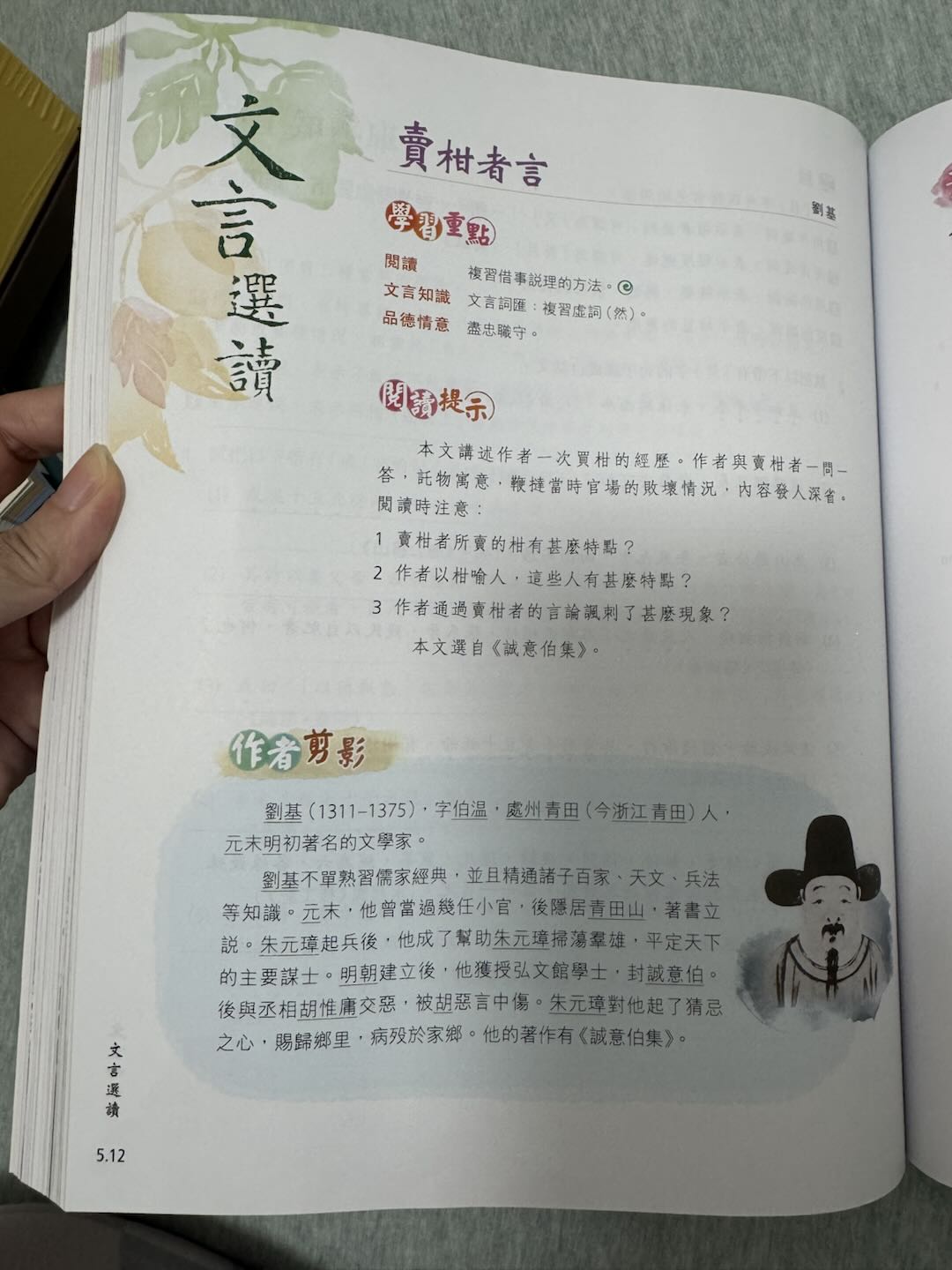
Page 5.12 · Reading guide for "Mai Gan Zhe Yan" (Learning Focus + Reading Hints + Author Profile)
"The Words of a Citrus Seller" by Liu Ji · Late Yuan – Early Ming · Classical Chinese Prose Classic · "A gilded exterior with rotten stuffing within"
Page 5.12 · Reading guide for "Mai Gan Zhe Yan" (Learning Focus + Reading Hints + Author Profile)
This essay recounts the author's experience of buying a citrus fruit. Through a dialogue between the author and the citrus seller, the author uses an object to convey a moral (托物寓言), lashing out at the corruption of the officialdom of his time — a thought-provoking piece.
While reading, notice:
This essay is from "Chengyi Bo Ji" (The Collected Works of the Earl of Chengyi). "Yan" means "words" or "remarks". The piece has the qualities of an allegory.
| Item | Details |
|---|---|
| Lifespan | 1311 - 1375 CE |
| Courtesy name | Bowen (伯溫) |
| Birthplace | Qingtian, Chuzhou (modern Qingtian, Zhejiang) |
| Era | Late Yuan – Early Ming |
| Reputation | A celebrated writer of the late Yuan – early Ming; founding hero of the Ming dynasty |
| Learning | Mastery of the Confucian classics and the hundred schools, astronomy, and military strategy |
| Early career | Held several minor posts in late Yuan; later retired to Mount Qingtian to write |
| Founding of the Ming | Became a key adviser helping Zhu Yuanzhang defeat rivals and unify the realm |
| Official title | Appointed Erudite of the Hongwen Academy; ennobled as Earl of Chengyi (誠意伯) |
| Downfall | Fell out with Chancellor Hu Weiyong, who slandered him to the emperor; Zhu Yuanzhang's suspicion was aroused; Liu Ji was ordered to retire to his home, where he died of illness |
| Collected works | Chengyi Bo Ji |
The essay was written in the late Yuan – early Ming. At the time, the officialdom was rife with corruption; officials held sinecures and deceived the public with empty reputations. Liu Ji uses the experience of buying a citrus fruit to employ an object as a metaphor for people (托物寓言), satirising the decay of the official world and expressing his dissatisfaction with corrupt officials.
| Term | Pronunciation | Meaning |
|---|---|---|
| Liu Ji | liú jī | The late Yuan – early Ming writer, courtesy name Bowen, Earl of Chengyi |
| Bowen | bó wēn | Liu Ji's courtesy name |
| Qingtian | qīng tián | Modern-day Qingtian, Zhejiang; Liu Ji's hometown |
| Earl of Chengyi | chéng yì bó | Liu Ji's noble title |
| Chengyi Bo Ji | chéng yì bó jí | Liu Ji's collected works |
| Hongwen Academy | hóng wén guǎn | A Ming-dynasty scholarly institution |
| Hu Weiyong | hú wéi yōng | Ming chancellor, who fell out with Liu Ji |
| Tuowu Yuyan | tuō wù yù yán | Using an object to convey a moral — a rhetorical strategy |
| Jieshi Shuoli | jiè shì shuō lǐ | Using a narrative of events to reason out a moral |
| Bianta | biān tà | To lash; to criticise sharply |
| Jinzhong Zhishou | jìn zhōng zhí shǒu | Faithfulness to one's duty |
| Function word "rán" (然) | rán | A classical function word meaning "however" or "thus" |
The essay is a textbook example of borrowing events to reason — through the experience of buying citrus fruit, Liu Ji argues that officials cheat the world with empty reputations and are thoroughly corrupt.
The essay uses the citrus fruit as a metaphor for corrupt officials:
The whole essay is propelled by a dialogue between the author and the citrus seller; the question-and-answer format makes the reasoning more thorough and the criticism sharper.
The essay uses strong contrasts:
The author uses rhetorical questions such as "those who are said to deceive others in the world" and "to whom shall they not be deceitful?" to provoke the reader's reflection.
Who wrote Mai Gan Zhe Yan? In which dynasty did he live?
The author is Liu Ji (1311-1375 CE), courtesy name Bowen, from Qingtian, Chuzhou (modern Zhejiang). He was a celebrated writer of the late Yuan – early Ming, a founding hero of the Ming dynasty, and ennobled as the Earl of Chengyi. His collected works are preserved in Chengyi Bo Ji.
When was this essay written? What is its purpose?
The essay was written in the late Yuan – early Ming. At the time, the officialdom was rife with corruption; officials held sinecures and deceived the public with empty reputations. Liu Ji uses the experience of buying a citrus fruit to employ an object as a metaphor for people, satirising the decay of the official world and expressing his dissatisfaction with corrupt officials.
From which collection is Mai Gan Zhe Yan taken? What does "yan" mean?
The essay is from Chengyi Bo Ji. "Yan" means "words" or "remarks". The piece has the qualities of an allegory and is a satirical essay.
How did Liu Ji meet his end? Why?
Liu Ji's end was tragic. He later fell out with Chancellor Hu Weiyong, who slandered him to the emperor. Zhu Yuanzhang's suspicion was aroused, and Liu Ji was ordered to retire home, where he died of illness. This shows that serving an emperor is like walking with a tiger — even meritorious ministers cannot escape an emperor's suspicion.
What are the main writing techniques of this essay?
The main techniques are:
What thoughts and feelings does this essay express?
The essay expresses Liu Ji's sharp criticism of official corruption, his disgust at those who deceive the world, and his yearning for loyal and upright men. Readers should learn to distinguish right from wrong, to be faithful to their duties, and never to be people of "a gilded exterior with rotten stuffing within".